Aug 31, 2026
In June 2026, I took part in the 28th International Planetarium Society (IPS) Conference in Fukuoka, Japan.
For me, this was much more than just a professional conference bringing together planetarium professionals from around the world. It was an opportunity to share with an international audience the story of Ukraine and Kharkiv, my own journey to Japan, and how a planetarium can continue its work even when the city is affected by war.
This year’s conference had a deeply symbolic theme: “One Earth, One Sky.” Under one sky in Fukuoka, planetarium professionals from different countries came together, speaking different languages, working in very different environments, and bringing a wide range of professional experience. For me, this was precisely what made IPS so special.
My Story in Japan — on the International Stage
My main presentation focused on my evacuating to Japan after the start of the full-scale war in Ukraine.
I spoke about how I came to Japan, the challenges I faced after arriving, and my efforts to understand a new country, find work, and continue my professional career as a planetarium presenter.
But the most important part of this story was about people.
Japanese colleagues, acquaintances, and friends helped me at different stages of this journey. Thanks to their support, I was gradually able not only to adapt to life in Japan, but also to return to my profession.
Several years after arriving in Japan, I now work at Galaxcity, one of Tokyo’s largest planetariums, and present programs at planetariums across Japan.
In this sense, my presentation at IPS was also a story about how a profession can help someone regain a sense of stability after being forced to leave their home.
Three Programs Under the Dome
In addition to my main presentation, I presented three programs in a mobile planetarium during the conference.
This was especially interesting for me because a mobile planetarium is very different from a permanent one. It makes it possible to create a small universe almost anywhere, while working in this format requires a completely different approach to both the program itself and interaction with the audience.
But perhaps one of the most unusual experiences at IPS came in a different format.
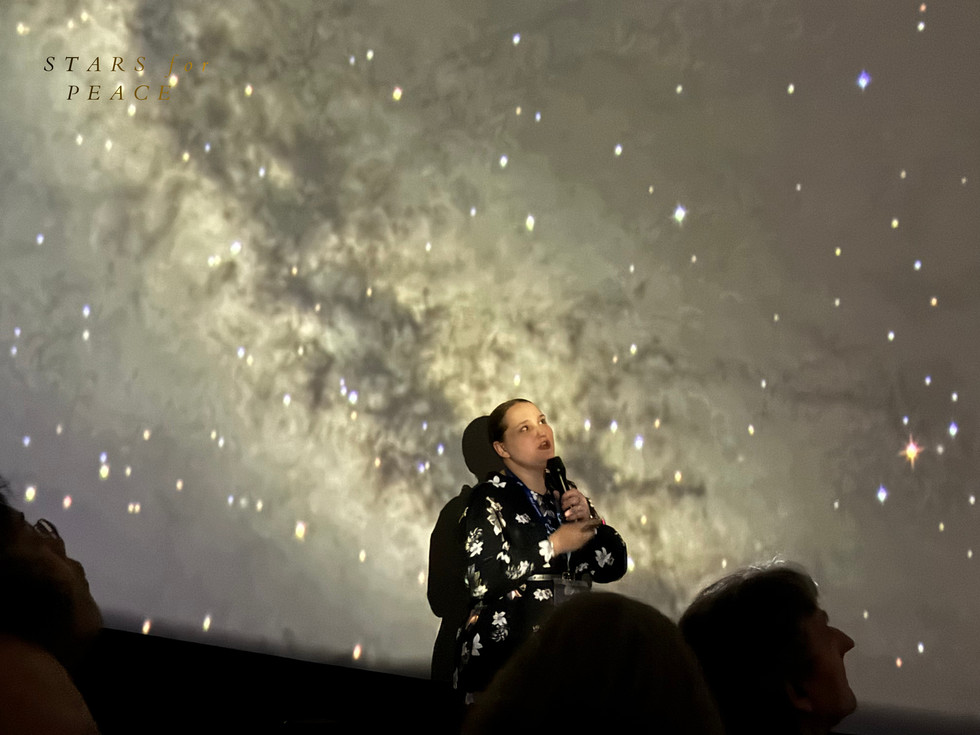
I was one of seven planetarium presenters from different countries who took turns giving live presentations of the night sky, each in their own language.
Seven people, seven languages, and the same sky.
At that moment, I felt more strongly than ever that the language of the night sky needs no translation. The stars are the same for everyone, even though every culture has its own way of talking about them.
Virtual Kharkiv Planetarium
At IPS, I also presented the “Virtual Kharkiv Planetarium” project.
https://www.stars4peace.com/virtualkharkivplanetarium
The idea for this project grew out of a desire to keep telling the story of the Kharkiv Planetarium and to continue its work even when the physical planetarium in Ukraine cannot operate in its usual format.
The virtual format makes it possible to share materials, talk about the stars, Kharkiv, and Ukrainian culture, and remain part of the international planetarium community.
Support I Will Never Forget
Preparing for IPS was challenging. There was never enough time, while the number of things that needed to be done just kept growing.
But there was one thing that appeared again and again throughout this experience: the support of others.
My Japanese colleagues helped me prepare, just as they have supported me throughout my life and professional journey in Japan — by offering advice, reviewing materials, helping with organization, and simply giving me words of encouragement.
But during IPS, I also felt the support of colleagues from other countries.
On the day of my main presentation, one of the conference participants happened to be wearing blue and yellow colors. Of course, she had not intended it as a symbolic gesture, but for me, it was a very heartwarming moment.
And after my presentation, one of the international participants called out:
“Slava Ukraini!”(Glory to Ukraine!)
At moments like these, you feel especially strongly that your story stopped being yours alone a long time ago.
More Than a Conference
For me, IPS 2026 was an opportunity to speak about Ukraine in a place where professionals from all over the world come together.
I shared my experience in Japan, presented planetarium programs, introduced the Virtual Kharkiv Planetarium, and joined colleagues from different countries in talking about the night sky in different languages.
But what stayed with me most was the sense of connection.
We may work in different countries, use different technologies, have different traditions, and speak different languages. Yet under the dome of the night sky, we are all looking in the same direction.
That is why, for me, the words “One Earth, One Sky” became more than just the theme of the conference.
They perfectly describe what planetariums exist for: not only to show people distant galaxies, planets, and constellations, but also to remind us that no matter where we were born or what language we speak, we share one Earth and one sky above it.